
Table of Contents
Absorption through immersion:
Absorption means sucking out things steadily. For example, being wet and drenched after diving in the water for a while due to absorption of water. More practically, put your dry dress into a bucket of water and see how it drenches and absorbs into the water gradually. Similarly, in language learning, we put ourselves into the environment we set through consumption: (listening, reading, & watching ), then live into it through sensory immersion day after day to let the brain absorb and suck out the language intuitively.
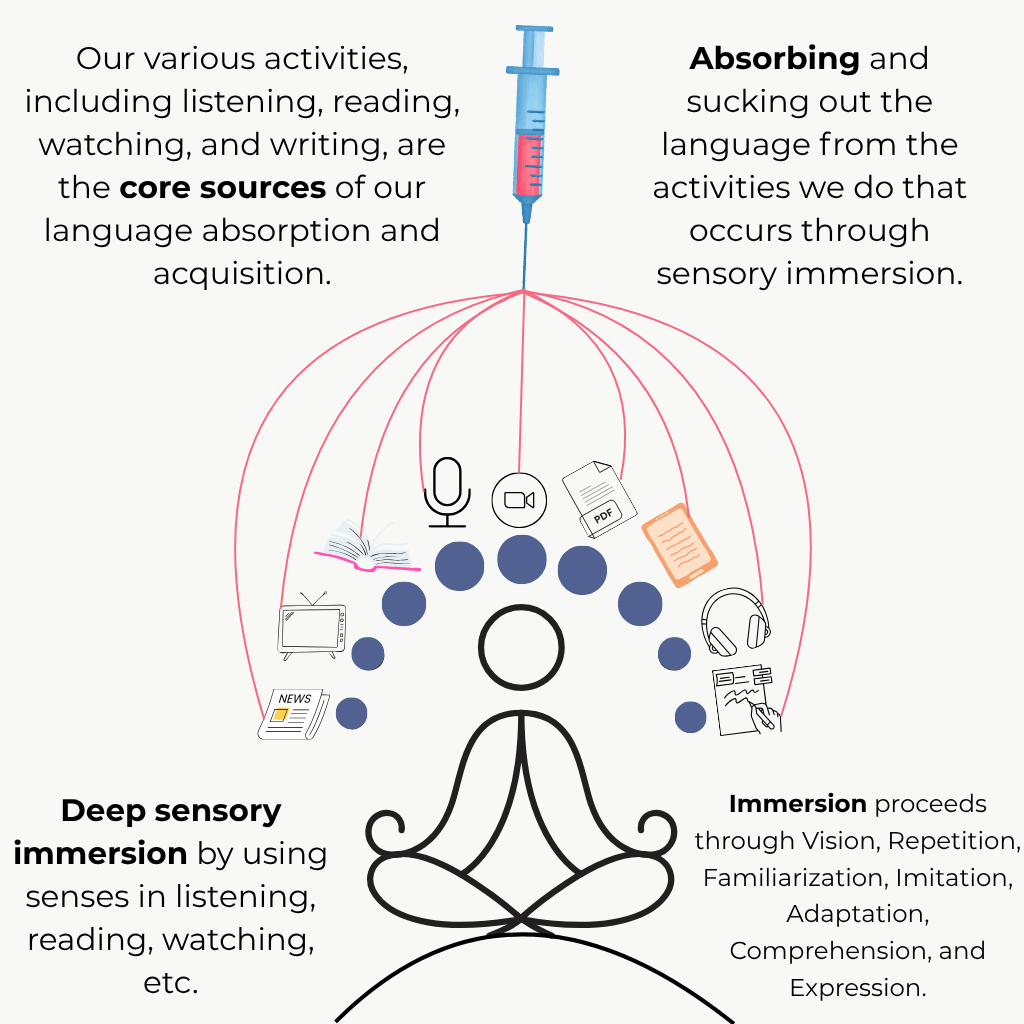
Language immersion is the most effective way to learn a language because it doesn’t require memorization and urgency; rather, it requires sensory immersion and focused attention.
Step 1: Immersion for language acquisition:
Immersion is the act of involving deeply into something through using the senses. Generally, we use listening, seeing, feeling, tasting, and smelling as the five senses in our actions. We may also use imagination, reflection, recollection, etc. These senses are the gateways of our being, living, and perceiving.
Here we will use sensory immersion method to aid our perception of a language to use it effortlessly in real life scenarios. In the context of language learning, we break down immersion into two categories: 1. Immersing into the day. 2. Immersing into the content.
Immersing into a day:
For language learning we’ve got three consumptions or exposures previously in our discussion on consumption section. They are listening, reading, watching. And immersing into a day meaning decorating your full day with those exposures through alignment based on timing & placement. Then, perform them separately by applying an immersion method.
Immersing into the content:
Immersing in the content of a language is the ultimate involvement in our acquisition. And this immersion proceeds through Vision, Repetitions, Familiarization, Imitation, Adaptation, Comprehension, and Expression.
Step 2: Vision for language acquisition:
Visioning has multiple meanings depending on context. In a general sense, having access and the capability to see things through eyes, or the perception to see things from experience and intuition. And I would like to represent the word ‘Vision’ in both ways: visioning through the eyes and visioning through the mind(Imagination).
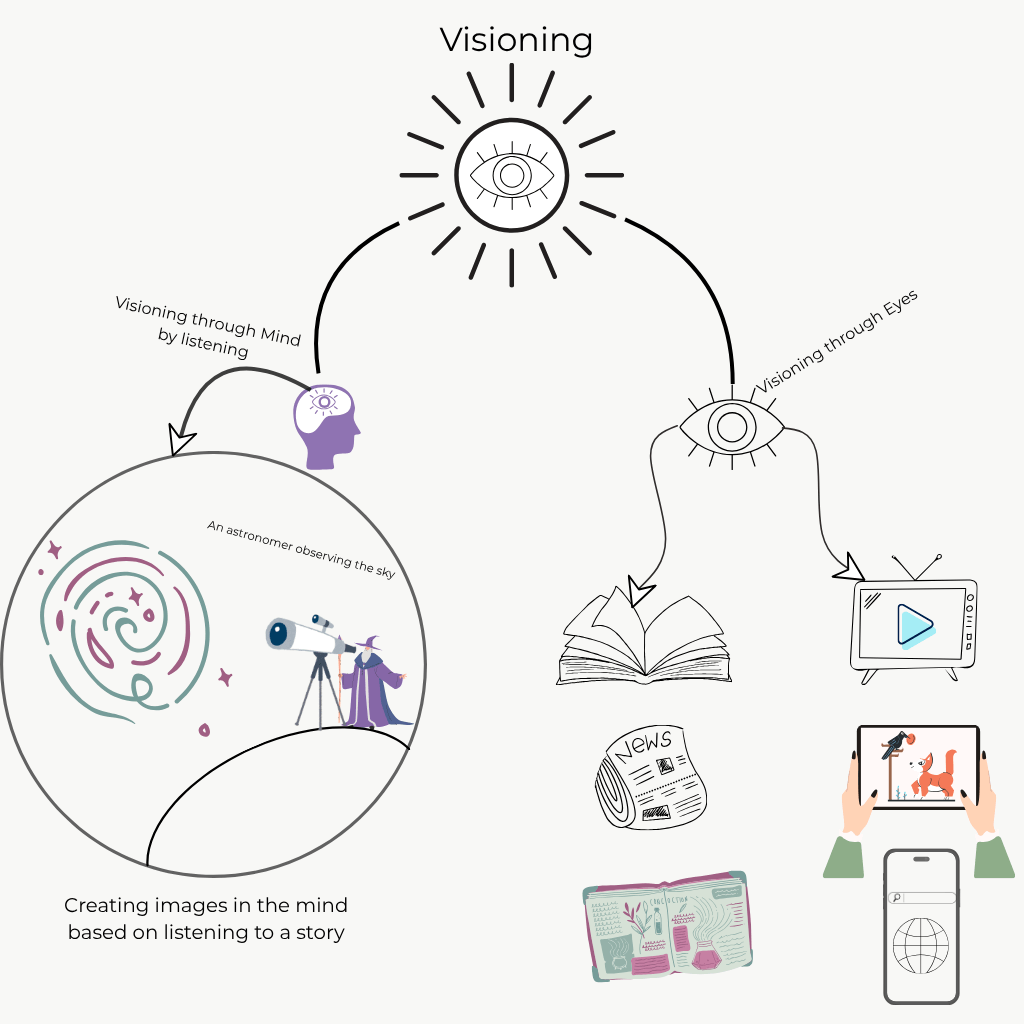
Visioning is an integral part of the immersion into the content of language learning because the mind and eyes are involved in everything. Almost 90% of information uses visioning. In the consumption section, we find three foods of language are listening, reading, and watching. And in all three activities, use the mind and eyes. Such as, in watching, we need the use of our eyes to see the scenes, and in listening, the mind sees things through imagination based on comprehension of the meaning. It’s really difficult to understand how one can understand meaning only through listening. Right? it’s completely up to the system to answer it below:
Visioning through the mind:
Visioning through the mind means using imagination: creating images based on your understanding of the expression and meaning of a language while listening. In the case of listening to a perspective story or a question-based story, we need to understand the meaning of the story to create an image in our mind to see it. For example, listening to the story of Coral Island where the narrator describes everything in full detail, and to create images based on his narration, we will have to apply the Inferring or guessing method to grasp the meaning of the words and sentences gradually to make scenes of it.
Inferring method: Inferring means interfering with or interrupting things in the middle. And in language learning, we will interfere and enter into the story’s narration to guess the meaning silently based on the context. For this, you have to be passionate enough to guess the meaning completely through repetition. The first time of listening to a story fully, you can grab the meaning of a few words, and based on that, you would create an overall scene of this story. Then, after several repetitions, you might find it more vivid and understandable because repetitions of the same action will determine your progress in comprehension.
Visioning through the eyes:
Seeing through the eyes is simple, just watching scenes on your screen and moving your eyes through the words and lines of a book’s pages.
Step 3: Repetition for language acquisition:
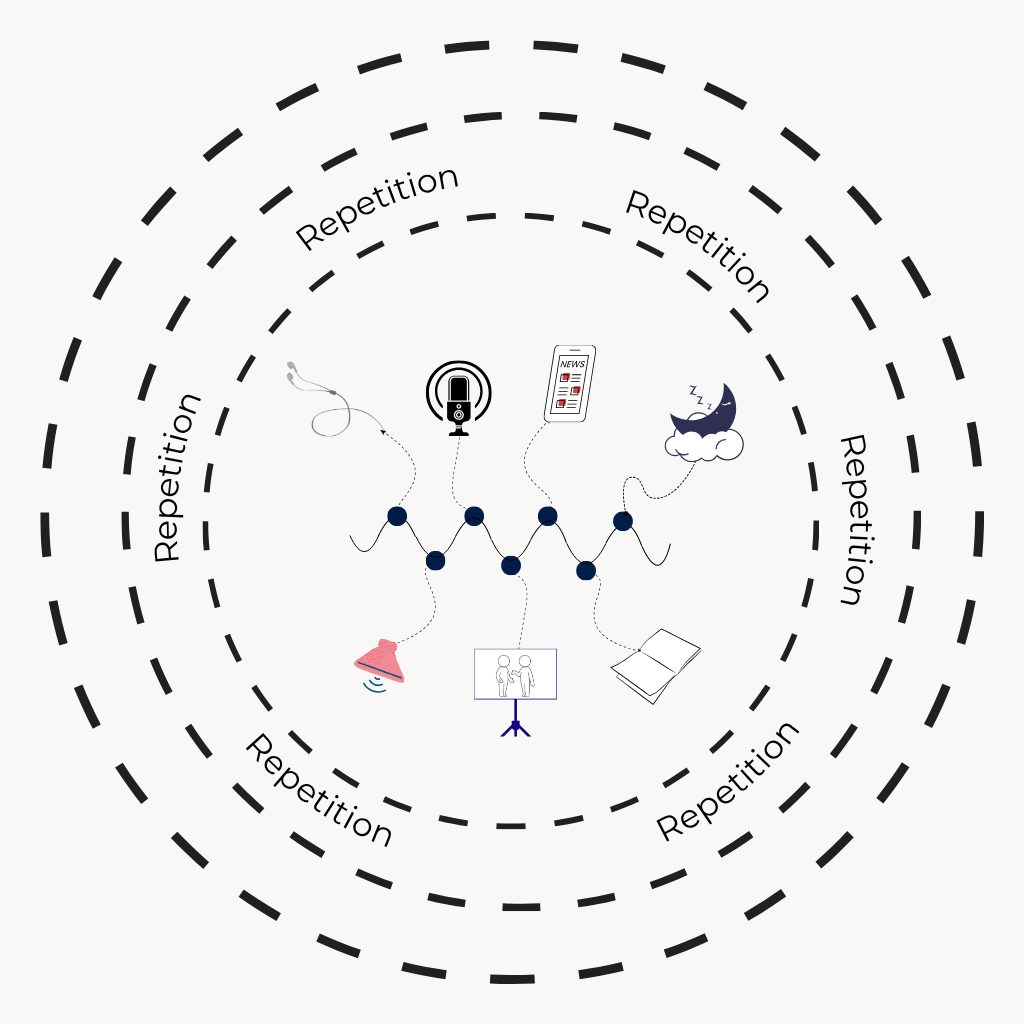
Repetition is the act of doing the same thing again and again or doing the same thing more than once. So, we will repeat the actions of visioning through the mind and eyes ( listening & reading ) to become familiar or acquainted with the content/materials. It might feel boring to repeat but experiencing the benefits it possesses are immense. You’ll experience new things in your every repetitions that steadily will reach you toward familiarization of the content. To repeat an action motivation requires to be filled. And motivation are two types: internal motivation and external motivation.
Internal motivation: it is a motivation that comes from inside of us through digging deeply into the actions by resonating and questioning. To repeat an action in language learning, internal motivation is mandatory. Such as, few things bring out inner motivation from an individual automatically if the content is funny, relatable, interesting, and pressure-free.
External motivation: motivation that arises from outside. For instance, why are you learning a language? Why is it needed for? The answers will determine your motivation level to perform the action repeatedly.
Step 4: Familiarization in language acquisition:
Familiarization is the process of increasing knowledge about a particular thing by spending time. It’s like a clearing out of a vision gradually in the dark after being in the light. Such as, when we spend time in the light for a decent period and then if we go outside in the dark immediately, we will experience the exact phenomenon that our vision is not clear enough to see things clearly, but you can understand this if you spend time in the dark first: the more you started to spending time in the dark after being in the light, the vivid your vision will become and be regained.
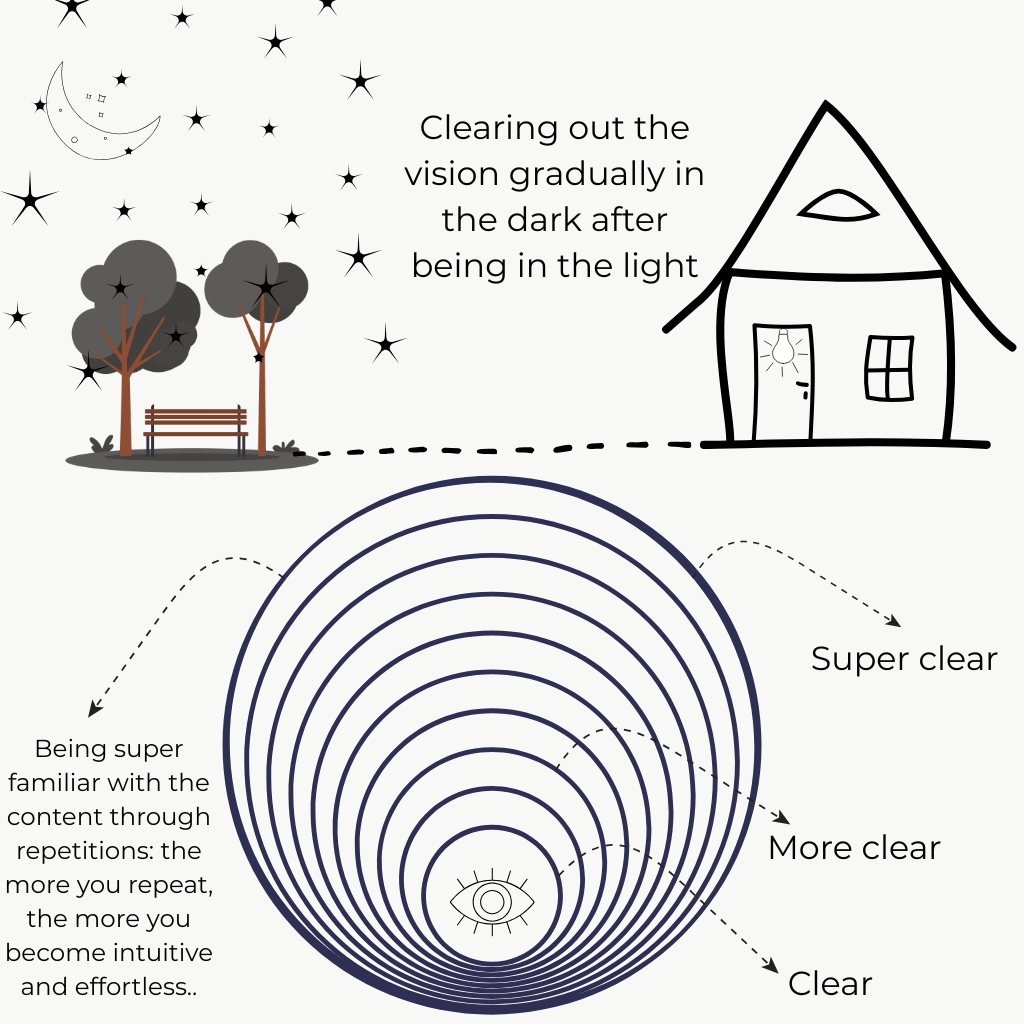
In language learning exactly the same way we will become acquainted with the content by repetition. The more we repeat an action, the easier its content will become. And the familiarization happens after weeks of repetitions of an action. For example, listening to a story for seven days will improve your 40% of understanding about it which will prepare you for Imitation through physical actions.
Step 5: Imitation for language acquisition:
Imitation is the replication of another’s behavior consciously and subconsciously. It’s an art of mimicry that is used in many cases such as in learning. In language learning, Imitation is consciously copying or parroting one’s speaking, writing, and acting. Subconscious imitation is also known for ‘mirroring’, which is important for cultural evolution and religious manifestation beyond genetics; for instance, virtues, certain teachings, etc. Or finding similar behaviors in the siblings, which often happens unconsciously because humans are prone to imitating others in their actions historically to adapt culturally and socially.
Anyway, after being familiar with the story through several repetitions, we need to step up to imitation to parroting or shadowing the story’s narration by using physical expressions. Now, shadowing/parroting is the copying of the narrator’s narration: you need to repeat the sentence loudly after the narrator finishes his sentence. If you struggle to do this, you need to extend the repetitions silently until you feel a little more comfortable and familiar with it.
Think about a filter which has few layers to clean up the water/comprehension and the familiarization is one of the layers that process your understanding of a story’s meaning through repetitions. One week of repetition silently will make you familiar and then 1/2 weeks of repetitions with the parroting or shadowing technique will enrich your comprehension further. Now, you need to apply shadowing technique with the physical expressions according to the meaning of the sentences that the narrator is narrating.
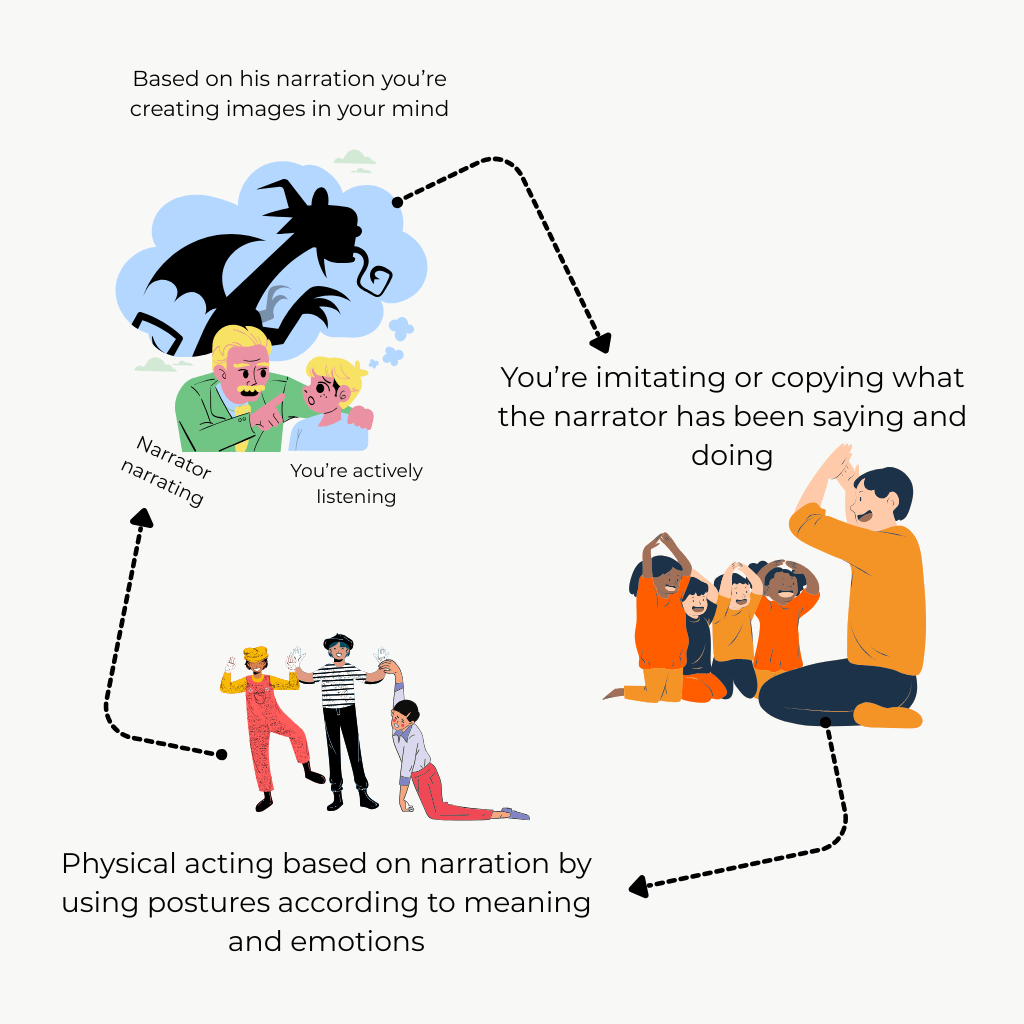
Physical expressions through acting: this idea I’ve got from seeing the acting show of ‘Mummer’ in Jamaica who had been demonstrating the meanings of a cultural story through their physical expressions mutely to the audience. Then, I experimented with this idea while listening to a story with the shadowing technique. To do this, you have to first guess the meaning, then act based on what the word or phrase is expressing. For example, “they went to the shop with no money”, first create an image of what it looks like: for me a guy with formal dress standing in front of a shop, and brings out his pocket japs outside. Then, I have to act exactly the image I created in my mind about this sentence and also loudly shadow it while acting because parroting it keeps the attention and focus vigorous. Then adaptation is another layer of purification of comprehension.
Step 6: Adaptation in language acquisition:
Adaptation refers to various meanings based on contexts. For me, adaptation is absorbing into a new environment or materials gradually, which becomes intuitive and effortless at a certain point. Such as, you have been doing an action for a long time repeatedly, and after a certain amount of time, you will find the action less hard than it was. Means, when you can do an action with less struggle and effort. Exactly, after plenty of repetitions, you will become familiar with the content like story listening. In this stage, you can easily understand 97% the meaning of what the narrator is narrating, and according to this narration, your physical expressions + shadowing will be smooth and fast. You need to continue your shadowing with a physical response to acquire and develop comprehension that lasts long.
Step 7: Comprehension phase in learning a language:
Comprehension is the state of being mastered in understanding things and being intuitive in expressing them, which requires plenty of repetitions of the same actions to build complete mastery. It occurs through the training of muscle memory to store the depth of the brain to respond subconsciously whenever it’s needed. And our subconscious mind is way faster than our conscious mind, which reacts to things so quickly that it takes 0.2 seconds. Thus, language acquisition happens subconsciously because it is impossible to react fast in our daily conversation through conscious effort to maintain flow. Though the conscious mind is used for making your ideas logical and forming your thoughts critical, not for expressing these ideas through a language, which happens intuitively.
And comprehension stores our input of a language that we do through the steps I’ve described. After firm establishment of our inputs, we reach an expression state where language expresses with its full potential.
Step 8: Expression in language acquisition:
Expression is the act or medium between a thing and our knowledge about it. And by practicing our language learning through sensory immersion, we develop knowledge or perception about things with full comprehension which leads to expression whenever things we see or think about them because our brain forms the thoughts so quickly that we express it unconsciously in conversations due to our deep repetitions in the process of immersion. For example, In my room I’ve many things; Table, Bed, Bookshelf, and I used to have expressions about these things in my mother tongue, the later it develops into English; whenever I see the bed, my mind automatically forms the word ‘bed’ to express it because plenty of time I’ve encountered this word in my stories & podcast listening, in watching videos while I would imagine the picture of bed shape in my mind, that my brain adapted with this subconsciously and now express it effortlessly.